People, Algorithms, Social media and the Fediverse
Why do users want algorithms despite their flaws, and do they fit into the Fediverse?
Published 2026-09-18
Every once in a while Fediverse users new and old talk about either lack of post on their timelines, or missing out on posts from low-volume posters that get drowned out by the higher-volume posters.
The Fediverse answer to the former is to follow more people, but who do you follow and how do you find them in the first place?
The latter is an even more difficult problem, partially created by the usual solution to the former.
What effective ways are there to pick posts from the noise
and bring them to the foreground so to speak?
One might gravitate towards subscribing to the user's posts, but that can easily flood notifications with unwanted posts.
Putting certain users into a list is another solution, but what if you want only certain kinds of posts from a user.
Let's say you are interested in an artist's drawings, but not interested in anything else.
Or certain topics a user talks about in general.
In other words what these people want is an algorithm that learns from their interactions/settings and gives certain content a priority over the rest. But there are numerous issues with creating such algorithm, let's explore.
The people
Even before social media, newspapers/magazines already figured out what makes their customers come back for more. And it's not positive news or positivity in general. What keeps people hooked is the opposite of that, it's negativity, controversy, drama, seeing someone else (especially a celebrity) be more unfortunate than them and get reduced from their perceived higher status to the status of the reader or even below. Gossip magazines have their whole business model based around this fact, newspapers in the last decades moved in the same direction as well. I don't remember the last time I saw a positive story written somewhere on the front page of a mainstream news site. Give it a try, you likely also won't.
The issue is that negativity sells and creates more engagement than positivity will. Social media companies sites figured that out fairly early as well, some even experimented with their users.
The algorithm
at least the fediverse proofs that it's not 'the algorithm' that makes people insane on social media
Most users are more likely to engage with negative content compared to positive content.
This is not because the algorithm
puts more negative content on their screens on their favorite social media site for the sake of it, it's because this is what most people engage with more.
If we base a recommendation algorithm purely on what content a user responds to, interacts with and writes about, the recommendations will eventually become biased towards negativity for most people.
Whenever a user complains that the social media site they use is toxic
, negative
or a similar term, the likelihood is high that they also engage with this content the most.
Either via calling out the users, replying to the posts or complaining about it.
The algorithm then takes this information as something the user wants more of and pumps more of it on their timelines.
I've recently revived my basically never used Twitter account after they sent cease & desist letters to most Nitter instances.
And compared to the ragebait content that was on my For you
2 years earlier, after blocking a few users, following few artists/photographers and fox posting accounts, I honestly cannot complain.
It contains only posts related to what I want and no content I don't want to see, like political ragebait.
And as expected, as I favorited certain posts, more similar posts popped up while the rest was toned down.
In other words the algorithm worked as expected, it gave me more of the content I engaged with.
This is maybe where some people would call this manipulating the algorithm
or something similar, self-admitting that they don't really have control over it.
Which while it is true to some degree, the only real input the algorithm has is engagement (or other data-mined heuristics the site acquires through other means, which in my case is none).
Still, a lot of the people, probably most, that complain about a negative/ragebaiting algorithm, do interact with the content they themselves complain about.
Possibly because deep down they seek what it gives them.
Users on the Fediverse that complain about these algorithms, especially on Bluesky and Twitter, can regularly be seen posting about the same topics they complain about on the Fediverse, to the extent that it almost is the how could this happen to me
meme.
Others complain about the perceived toxicity and hostileness of the Fediverse, while they are very active on the #fediblock tag and talk about seeking out this content to weed it out of the Fediverse
.
Nevertheless, I don't seek out this content and my timelines, including TWKN, remain almost toxicity free, despite supposedly being on the Dark Fedi
where this content is supposed to be prevalent.
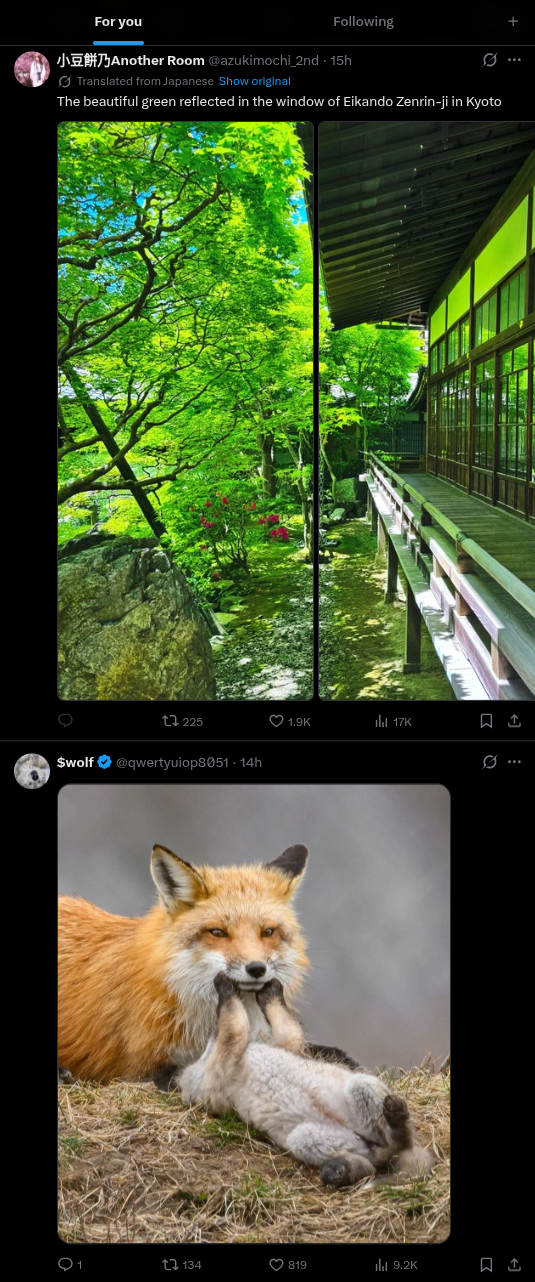
Don't believe me about my great Twitter For you
timeline? Enjoy these nice photos.
The Fediverse
If we completely ignore the computational costs of running a recommendation and post categorization algorithm on Fediverse instances, there are still multiple issues with integrating such algorithm in to the Fediverse.
Firstly, a large part of why people come to the Fediverse is because they are privacy conscious, to them an algorithm that tracks their activity is a deal-breaker. And even if users have a universally agreed upon way of indicating that they don't want their posts to be indexed by an algorithm, the algorithm will lose most of its purpose since it won't know about most of the content to recommend in the first place. We already had this divide and large drama when Fediverse servers implemented full-text search for posts to let users find what they want.
Secondly, even if someone makes a private recommendation/filtering algorithm for them, other users will be enraged at the idea that their posts are being funneled to some algorithm by someone else and witch hunt them on #fediblock. This has already happened with the developer of Ktistec after implementing the MCP protocol.
Thirdly, a large part of marketing the Fediverse over the years was that there is no algorithm which decides what ends up on user's timelines. Implementing such algorithm, even completely in good faith with full privacy controls, would break this point. Same with chronological timelines, which an algorithm would not be able to effectively work with.
Lastly, users will still engage with negative content more than positive, leading to the same issues as on other social media sites.
This can be partially mitigated by requiring a user to input several keywords for posts they would like to see more.
But nothing is stopping them from putting politics
into that list, which is a valid interest, but it also leads to negative content as written above.
The idea of an algorithm is flawed because of this, if the platform wants to promote good content instead of keeping engagement at the maximum at the cost of user sanity.
So far I have not come up with a solution to properly fix this, besides just turning the recommendations off in user settings.
Due to the 4 points above, I think that content algorithms won't become widespread on the Fediverse, at least not in the near-ish feature, despite some users clearly wanting them (without knowing/understanding what they want is a recommendation algorithm).
Workarounds like hashtags aren't of much use on platforms with proper full-text search, hence why they are rarely used outside of Mastodon, and they are prone to spam (including hashtag spam in the post itself to improve visibility).
Lists aren't ergonomic enough for some of the use cases, like a list of artists only with their drawings (media).
Which is something that can at least be implemented.
Another possible workaround is custom timelines that contain only posts with specific keywords and a set of conditions, Misskey has such feature with Antennas.
But still no way to help new users find accounts they might be interested in following based on their other follows. Allowing users to highlight other accounts in their bio is an option though.
You can comment on this article on the Fediverse: https://fluffytail.org/objects/2585eea9-ea8d-4bc0-ba31-762030ea8f53